
How Things Turned Out OK: Imagining Iowa’s Food and Ag Future

I am very fortunate to spend a lot of time around hundreds of people who are trying to make Iowa’s food system a better place. It makes it easy to imagine a future where our economy, our landscape, and our public health look a lot different.
The people I have the privilege of working with include:
Farmers diversifying their crops and working to improve soil health and water quality
School food service directors cooking from scratch, sourcing locally, and trying to feed children healthier meals
Teachers and non-profit staff educating students and young workers how to farm in a sustainable way
Doctors, dieticians, and state agency officials connecting local food and human health
Entrepreneurs building local food businesses to connect farms with consumers
County supervisors, city council members, and other local leaders using creative mechanisms, like starting local food policy councils and opening free community fridges, to keep rural towns vibrant and provide local food access to everyone.
And despite all that good work, I often hear the same feeling expressed in different ways: The problems seem bigger than our ability to solve them. Whether we’re talking about water quality, public health, economic inequality, food insecurity, rural population decline, or the challenges facing beginning farmers, it can feel like we’re constantly fighting uphill battles. Many of us spend so much energy responding to crises that we rarely have time to imagine something different.
Recently, I read Rob Hopkins’ book From What Is to What If?, which helped me understand why. Rob also happens to be a regenerative farmer from the United Kingdom. Hopkins argues that one of the greatest casualties of modern life is our imagination. We have become so consumed by the demands of surviving within our current systems that we struggle to envision alternatives. We become trapped in “what is” instead of asking “what could be?”
Yet, he adds, every major change in history began with imagination. Before there was a civil rights movement, someone imagined a more just society. Before there were public schools, someone imagined universal education. Before there were farmers markets, conservation programs, food banks, community gardens, and local food hubs, someone imagined them first. Imagination is not a luxury. It is a necessity, because it is a prerequisite for any positive social change. So I want to invite you into an exercise.
Imagine it is the summer of 2036, and, as Rob puts it, that things have “Turned Out OK” for Iowa.
You are driving through the countryside on a June evening. The landscape still includes corn and soybeans - this is Iowa, after all - but it is more diverse than it once was. Prairie strips, orchards, vegetables, grazing livestock, small grains, and perennial crops are common sights. Streams run clearer than they have in generations. You arrive at a farm hosting a community gathering. Families fill the grounds. Most of the food on the tables was grown nearby. Children run between picnic tables while musicians tune their instruments. Neighbors know one another. This is a local Summer Solstice Celebration, one of hundreds happening around Iowa tonight. Nothing about the gathering feels unusual. This is simply what a community looks like.
As the evening unfolds, you meet young farmers who recently moved to Iowa because farming once again offers a viable livelihood. They are succeeding because local markets, food hubs, processing facilities, and public institutions have created reliable pathways to profitability.
Last week, you attended a “pay-what-you-can” local strawberry festival. Families gather to celebrate the harvest, regardless of their income. Food has become part of Iowa’s culture again, not merely a commodity. In their elementary school class this past school year, your children learn where their food comes from. Farmers visit their classrooms. The meals they eat in the cafeteria are completely free to all students, and they feature ingredients grown by people students know by name.
Your father has struggled with diabetes for decades. Now, when he visits a doctor’s office, he receives prescriptions that connect him to healthy foods grown by local producers. Healthcare providers understand that healthy communities begin with healthy soil.
Local restaurants, and even your favorite chains like Casey’s and Culver’s, proudly participate in a state program that reinvests 1% of all hospitality business sales revenue into a “Community Regeneration Fund” that provides grants to support land access, conservation, local food infrastructure, and beginning farmer programs. Customers support it because they can see the results in their own communities. Restaurants have started sourcing as much locally as possible, and the price of local foods is coming down as the scale of production increases.
Ten years ago, your friends from Sudan and Guatemala worked long grueling hours at the JBS Meatpacking Plant in Marshalltown, and they could barely scrape by enough to provide for their families. Today, through a revolving loan fund called the “Butchery Innovation Fund,” they have been able to purchase their own small-town meat locker, where they employ 50 other Iowans processing exclusively pasture-raised meats for hundreds of Iowa farmers. Additionally, their business provides all the meat for the Sudanese restaurant and the Guatemalan restaurant that opened on Main Street.
Most importantly, rural communities are growing again. People are moving here from the coasts and from all over the world. Main streets are busy. Schools are stable. More young people can envision a future for themselves in Iowa. Our community diversity is our strong suit. Iowa has become a “Good Food Capitol of the United States.”
None of this happened because of a miracle. It happened because thousands of Iowans spent years asking a simple question: “What if?” Eventually, enough people began asking a second question: “Why not?” The encouraging thing is that pieces of this future already exist.
After all, we have soils that rival the best in the world and a culture that prides itself on farming and rural communities. We already have farmers improving soil health and protecting water quality. We already have schools buying local food. We already have food hubs, farmers markets, community organizations, healthcare innovators, entrepreneurs, and local food policy leaders proving that different models can work. We already have a state-managed butchery innovation fund. The future is not something we have to invent from scratch. The future already exists - in pieces. Our challenge is to connect those pieces and scale what works.
If we want to move toward this vision, several actions would help. We can expand local food purchasing programs that connect Iowa farmers with schools, food banks, and public institutions. We can invest in local processing infrastructure that allows more food dollars to remain in Iowa communities. We can create new pathways for beginning farmers to access land, capital, and training. We can support food-as-medicine initiatives that improve public health while creating new markets for producers. We can reward stewardship practices that improve soil health and water quality while maintaining farm profitability.
But perhaps the most important action is simpler. We must reclaim our ability to imagine. Because every policy, every institution, every movement, and every transformation begins with a vision of something better. The future Iowa needs is not beyond our reach. The question is whether we can imagine it clearly enough - and believe in it strongly enough - to build it together.
About the Author
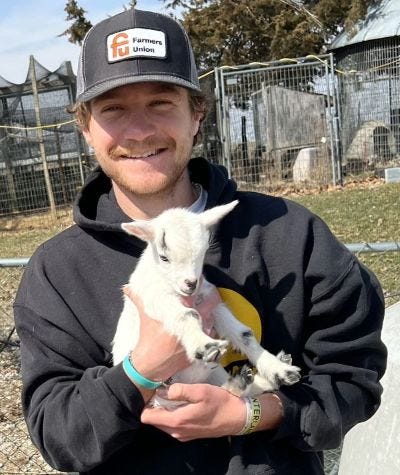
Tommy Hexter is the Executive Director of the Iowa Food System Coalition, a statewide network of more than 60 organizations working together to build a healthier, more resilient, and more equitable food system for all Iowans. He grew up on a small vegetable and egg farm in central Virginia and has lived in Iowa since 2017. He previously was the Executive Director of Grinnell Farm to Table and the Policy Director for Iowa Farmers Union. His work focuses on strengthening local food economies, supporting farmers and food businesses, improving food access, and advancing policies that connect healthy soil, healthy food, healthy communities, and healthy ecosystems.
About the Iowa Food System Coalition
The Iowa Food System Coalition brings together farmers, businesses, nonprofit organizations, healthcare leaders, educators, conservation advocates, and community members around a shared vision for Iowa’s food future. The coalition’s statewide food system plan, Setting the Table for All Iowans, outlines strategies to strengthen local food systems, improve public health, support economic development, expand opportunities for farmers, and protect Iowa’s natural resources.
To learn more, get involved, or read the coalition’s food system plan, visit the Iowa Food System Coalition and join the growing network of Iowans working to build the future described in this essay.
 | A guest post by
|
Thank you Tommy for helping connect the dots. There are so many systems in place to be connected. Iowa must have the political will to support efforts to make Iowa a state people like you want to come to actually live here. So much potential.
Tommy! Thank you for this!
I agree that the ceiling on American prosperity rn is NOT a lack of resources, desire, or manpower -- it's a lack of imagination to consider we -- the lowly human beings of 2026 America -- could possibly envision anything better than the generations before us. We lack a fundamental courage to say we can (and must) build systems that work for us in real time. We do that by (OF COURSE) honoring our fundamental principles whenever and wherever they are truly implicated, but beyond that, government is the only system that can and should be in the business of making huge strides in the name of making people happier and healthier (PROFIT MARGINS BE DAMNED).